Overview
This article summarizes the Mutation-Based Fuzzing chapter, focusing on seed mutation, coverage-guided selection, and the Fizzbuzz demonstration.The Limitation of Random Generation
Random generation often fails on structured inputs because it produces strings that are syntactically invalid far more often than valid ones. For a URL, even a simple value like http:// has a very specific prefix, and the probability of generating it at random is extremely small. The chapter illustrates this with a URL parser example: the chance of producing a valid http:// prefix using printable ASCII characters is roughly \(1 / 96^7\), and the odds are even lower for https://. In practice, this means a purely random fuzzer may spend enormous amounts of time generating strings that are rejected almost immediately, without ever reaching the interesting logic of the program.
What Is Mutational Fuzzing?
Mutation-based fuzzing avoids the problem of generating valid inputs from scratch by starting from an existing valid seed and applying small changes to it. A mutation might delete a character, insert a random character, or flip a bit in a character. Because the input remains close to the original, it is far more likely to remain parseable and useful. This approach is especially effective for inputs with fixed structure, such as URLs, file paths, or network protocol messages.
The idea is simple but powerful: if a program accepts a valid input, then a slightly modified version of that input may still be valid while exercising a different path or edge case. This makes mutational fuzzing a practical compromise between pure random generation and a full grammar-based generator.
Fuzzing a URL Parser
The chapter uses a URL parser as a motivating example. A URL is typically structured as:
scheme://netloc/path?query#fragment
where the scheme is something like http or https, the net location is the host such as www.google.com, and the path and query further specify the resource. In Python, urllib.parse.urlparse() decomposes this structure into named parts, making it easy to validate whether a URL is well-formed.
The chapter then defines a tiny http_program() that accepts only http and https URLs with a non-empty host. As expected, random fuzzing almost never produces a valid URL, so the parser is rarely exercised beyond input validation. This illustrates the key limitation of generational fuzzing for structured data and motivates mutation-based strategies that begin from a valid URL instead of a random string.
Primary Mutation Operators
The core mutation operators are intentionally small and easy to implement. The chapter introduces three standard ones:
- Delete: remove a random character from the input.
- Insert: add a random printable character at a random position.
- Bit flip: randomly choose a byte and flip one of its bits, which can turn one character into another and produce surprisingly realistic variants.
These operators are usually combined in a single mutator that chooses one of them at random and applies it to the current string. Even a small mutation can produce new and interesting test cases while preserving much of the original structure.
Mutating URLs in Practice
The chapter then applies these mutations to a valid URL such as:
http://www.google.com/search?q=fuzzing
When the mutation process is applied to this seed, a surprisingly high percentage of the resulting strings remain valid. Mutating valid inputs preserves syntactic validity much more often than generating random strings from scratch. This allows the fuzzer to stay near the grammar of the original input while still exploring nearby variants, such as slightly different hosts, schemes, paths, or query strings.
The authors also show that a valid seed can help discover new variations such as https://, which would be dramatically harder to reach through pure randomness. In other words, mutation allows the fuzzer to take a known-good input and slowly explore the neighborhood around it.
Stacking Multiple Mutations
A single mutation is often enough to produce a small variation, but real progress usually comes from chaining many mutations together. The chapter applies dozens of mutations to the same seed and shows how the resulting strings quickly diverge from the original while still retaining some useful structure. This increases diversity in the generated inputs and enables the fuzzer to reach different code paths without needing a precise grammar.
To support this, the book introduces MutationFuzzer, which keeps a seed corpus, chooses a population member, applies a random number of mutation steps, and emits a candidate input. This creates a simple but effective generative loop: valid seeds are mutated repeatedly to explore new behavior in a controlled fashion.
Guiding Mutations with Coverage
When mutating inputs blindly, many mutations quickly make an input syntactically invalid, causing the target program to reject it immediately. As a result, blind mutational fuzzing eventually gets stuck. To solve this, coverage-guided fuzzing (pioneered by tools like American Fuzzy Lop / AFL) uses feedback from code execution to guide the mutation process:
Population/Seed Corpus: The fuzzer maintains a pool (population) of interesting inputs, initialized with one or more valid sample inputs (seeds).
Execution and Instrumentation: The fuzzer executes the target program with a mutated candidate input and measures which code locations (statements or branches) were executed (using coverage tracking/instrumentation).
Feedback Loop: If a mutated candidate covers new code (i.e., reaches new statements or branches not seen before in the cumulative coverage set), the candidate is considered valuable. This candidate is then added to the population of inputs.
Evolutionary Search: By continually picking inputs from the updated population and mutating them further, the fuzzer gradually “learns” how to bypass complex parsing checks, reach deeper execution paths, and maximize overall code coverage without needing a formal input grammar.
The MutationFuzzer Architecture
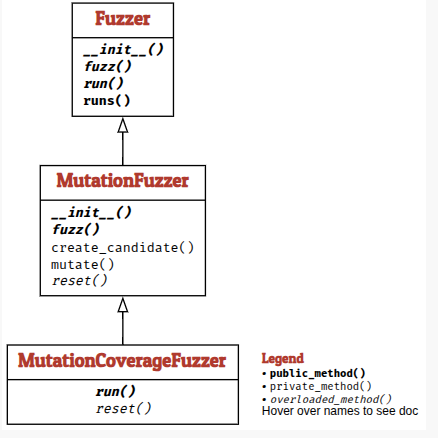
The chapter structures the mutational fuzzing framework using an object-oriented design in Python that builds upon a base Fuzzer hierarchy:
Mutation Operators: Basic helpers (delete, insert, bit-flip) that perform random character or bit modifications on input strings.
MutationFuzzer: Takes initial valid seeds, randomly picks one, applies \(N\) mutations, and returns a new candidate input.
MutationCoverageFuzzer: Extends the basic fuzzer with an evolutionary loop—it tracks executed code lines and adds any mutated input that reaches new coverage back into the active seed pool.
Key Lessons
A few important takeaways from the mutation-based fuzzing chapter:
- Mutation-based fuzzing generates new inputs by applying small changes to existing, valid seed inputs.
- Valid seeds allow fuzzers to bypass basic parsing logic and reach deep, complex code paths without needing a full input grammar.
- Coverage tracking acts as an evolutionary guide, helping the fuzzer identify which mutations explore new territory.
- Adding high-coverage inputs back into the seed pool creates a feedback loop that continuously improves test generation.
- Hybrid techniques like mutation-based fuzzing offer a practical balance between low-effort setup and high code reach.
Q1. What is the primary advantage of mutation-based fuzzing over purely random fuzzing?
Click to Expand for the Answer
Answer! It leverages valid seed inputs to stay close to syntactically correct structure and reach deeper code paths.
Q2. How does coverage-guided fuzzing use the seed population?
Click to Expand for the Answer
Answer! It dynamically adds mutated inputs to the seed population whenever they discover new code execution paths.
Mutation-based fuzzing is not a magic bullet—it can still get stuck on strict multi-byte checks or complex validations without assistance like dictionaries or symbolic execution. However, when combined with coverage feedback, mutation fuzzing provides an efficient, automated method for surfacing hidden edge cases and vulnerabilities in software.
Our team built Fizzbuzz, a command-line program that shows code coverage in action. You can view the project here: Fizzbuzz on GitHub.
Return to Blog Post Listing